my tours with
tropical birding
my artwork
my photos
my organizations
my links
birding mclean county
more about me
contact me
The Latest
It's been a whirlwind
year for me thusfar. I spent most of January–May travelling: Costa
Rica, Mexico, Guatemala, Texas, and Ohio. During that time I
was hired as editor
of ABA's Winging It. Right
now I'm
"relaxing" by completing trip
reports and putting together my first issue of Winging It. Later this
summer I'll lead a fundraising trip to Ecuador for the Illinois Ornithological Society,
and I'll lead trips at the Rio
Grande Valley Birding
Festival in November.
You can see my most recent "Sightings" column from Birding and Winging It here.
You can see my most recent "Sightings" column from Birding and Winging It here.
MISCELLANEA
The 51st Supplement to the AOU Checklist contains four notable changes for ABA Area birders.
1. Black Scoter was split into Melanitta americana and M. nigra. The former is found in the New World. The latter, the Old. The Supplement calls M. americana "American Scoter", but Andy Kratter, a member of the Checklist Committe, posted this on Birdforum today: "We made a mistake on the English names of the Scoters...We are going to publish errata in the next Auk that will have nigra = Common Scoter, and americana = Black Scoter.
2. Greater Shearwater (Puffinus gravis) becomes Great Shearwater, to agree with usage elsewhere in the world.
3. Whip-poor-will was split into Eastern Whip-poor-will (Caprimulgus vociferus) and Mexican Whip-poor-will (C. arizonae). The former breeds in the deciduous forests of eastern North America; the latter, in montane pine forests of Mexico and the southwestern U.S.
4. Winter Wren was split three ways: Winter Wren (Troglodytes hiemalis), Pacific Wren (T. pacificus), and Eurasian Wren (T. troglodytes). Winter Wren's range roughly corresponds to that of Blue-headed Vireo; Pacific Wren's is like that of Cassin's Vireo; and Eurasian Wren ("The Wren") is distributed across temperate Eurasia.
Further afield, the Elepaio was split three ways: Kaua‘i ‘Elepaio (Chasiempis sclateri), O‘ahu ‘Elepaio (C. ibidus), and Hawai‘i ‘Elepaio (C. sandwichensis).
White-tailed Trogon (Trogon chionurus) is split from Green-backed Trogon (T. viridis).
Gartered Trogon (T. caligatus) is split from Violaceous Trogon (T. violaceus).
Ecuadorian Trogon (T. mesurus) is split from Black-tailed Trogon (T. melanurus).
Greater Antillean Oriole is split into four species: Bahama (I. northropi), Cuban (I. melanopsis), Hispaniolan (I. dominicensis), and Puerto Rican (I. portoricensis) orioles.
Crowned Slaty-Flycatcher becomes Crowned Slaty Flycatcher.
Most of the other changes involve classification, especially of warblers, both Old and New world.
The Brown Jay gets its own genus and becomes Psilorhinus morio.
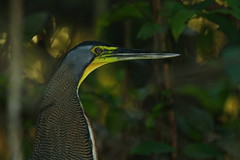 Ardeadae (the heron family) and Threskiornithidae (ibises
and
spoonbills) were transferred from Ciconiifrmes (the stork order) to
Pelecaniformes (the pelican order).
Ardeadae (the heron family) and Threskiornithidae (ibises
and
spoonbills) were transferred from Ciconiifrmes (the stork order) to
Pelecaniformes (the pelican order).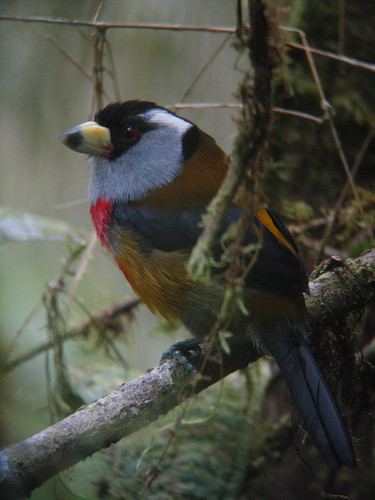
New orders were created: Accipitriformes (non-falcon hawks split from falcons), Eurypygiformes (Sunbittern and Kagu split from cranes and rails), Phaethontiformes (tropicbirds split from pelicans), and Suliformes (gannets and boobies, cormorants, frigatebirds, and anhingas split from pelicans).
As were new families: Pandionidae (Osprey split from hawks), Capitonidae (American barbets split from toucans), Semnornithidae (toucan-barbets split from toucans), Calcariidae (longspurs and snow buntings split from emberizids), and Viduadae (whydahs and indigobirds split from estrilid finches). Split off from the massive Old World warbler family, Sylviidae, were half a
 dozen
smaller familes, including
Polioptilidae (gnatwrens and gnatcatchers),
Cettidae (bush-warblers),
Phylloscopidae (leaf-warblers), Acrocephalidae (reed-warblers),
Donacobiidae (donacobius), and Megaluridae (grasshopper-warblers and
grassbirds).
dozen
smaller familes, including
Polioptilidae (gnatwrens and gnatcatchers),
Cettidae (bush-warblers),
Phylloscopidae (leaf-warblers), Acrocephalidae (reed-warblers),
Donacobiidae (donacobius), and Megaluridae (grasshopper-warblers and
grassbirds).Speaking of which, the genus Chamaea (Wrentit) is moved into the family Sylviidae ("classic" Old World warblers).
The genus Lipaugus (typical pihas) was added to Cotingidae (the cotinga family).
Now onto the New World warblers.
Blue-winged Warbler becomes Vermivora cyanoptera.
 The genus Vermivora now
comprises only Blue-winged, Golden-winged, and Bachman's Warblers.
The genus Vermivora now
comprises only Blue-winged, Golden-winged, and Bachman's Warblers.The new genus Oreothlypis contains Tennessee, Orange-crowned, Nashville, Virginia's, Colima, Lucy's, Flame-throated, and Crescent-chested warblers. The last two species were formerly in Parula.
The waterthrushes get their own genus, Parkesia. This means that Ovenbird is now in its own genus.
The "brown towhees" (California, Canyon, Abert's, and White-throated) are transferred into the ground-sparrow genus, Melozone.
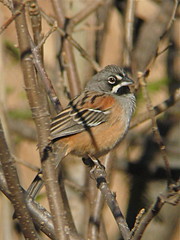
Many former members of Aimophila are split off into the new genus Peucaea: Cinnamon-tailed, Rufous-winged, Stripe-headed, Black-chested, Bridled, Botteri's, Cassin's, and Bachman's sparrows.
Five-striped Sparrow is yet again moved into the genus Amphispiza, with Black-throated and Sage sparrows.
McCown's Longpsur get its own genus, Rhynchophanes, because it is more closely related to Snow Bunting than it is to the other longspurs. Not only that, but longspurs and snow buntings get their own family, Calcariidae, which comes between Olive Warbler and the New World warblers.
The following proposals were voted down:
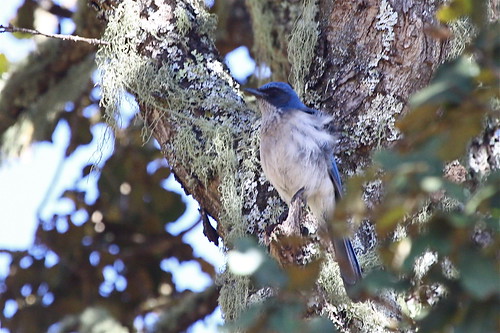
1. Splitting Western Scrub-Jay
2. Splitting Curve-billed Thrasher
3. Splitting South Hills Crossbill from Red Crossbill
4. Splitting Leiothlypis from the new genus Oreothlypis
===============================================
The 2009 AOU Checklist supplement is out. Among the changes that will impact US and Canadian birders are . . .
 1. And this is the BIG one.
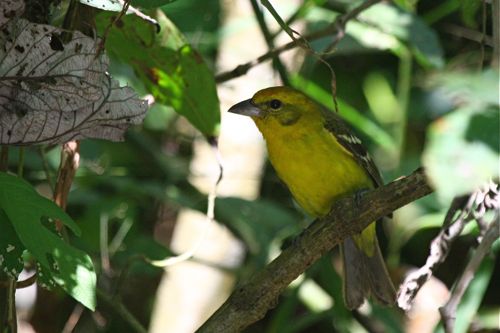
The genus Piranga (Scarlet,
Summer, Western, and Hepatic Tanager, among others) moves from
Thraupidae (the tanager family) to Cardinalidae (the cardinal family).
This makes sense to most people who've spent a good deal of time with
both Piranga "tanagers" and
real tanagers from the tropics. There is no common name change.
1. And this is the BIG one.
The genus Piranga (Scarlet,
Summer, Western, and Hepatic Tanager, among others) moves from
Thraupidae (the tanager family) to Cardinalidae (the cardinal family).
This makes sense to most people who've spent a good deal of time with
both Piranga "tanagers" and
real tanagers from the tropics. There is no common name change.2. Common name change for the "Sharp-tailed Sparrows":
Nelson's Sharp-tailed Sparrow becomes Nelson's Sparrow.
Saltmarsh Sharp-tailed Sparrow becomes Saltmarsh Sparrow.
3. A major split of the genus Carduelis. ABA Area birders will feel this effect with the following updates to scientific names:
Spinus spinus Eurasian Siskin
Spinus pinus Pine Siskin
Spinus lawrencei Lawrence's Goldfinch
Spinus psaltria Lesser Goldfinch
Spinus tristis American Goldfinch
Acanthis flammea Common Redpoll
Acanthis hornemanni Hoary Redpoll
Chloris sinica Oriental Greenfinch
4. A group of extinct Hawaiian birds, the ‘Ō‘ōs and the Kioea, gets its own family, Mohoidae.
5. A change in the specific epithets of two chickadees in order to follow the gender (male) of the genus.
Poecile hudsonica becomes P. hudsonicus Boreal Chickadee
Poecile cincta becomes P. cinctus Gray-headed Chickadee
Those who venture into Middle America and the Caribbean will notice further changes.
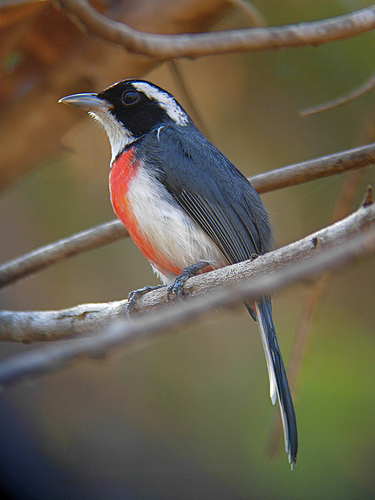 6. The genus Granatellus
(including Red-breasted and Gray-throated Chats) is moved from
Parulidae to Cardinalidae. There
are no common name changes.
6. The genus Granatellus
(including Red-breasted and Gray-throated Chats) is moved from
Parulidae to Cardinalidae. There
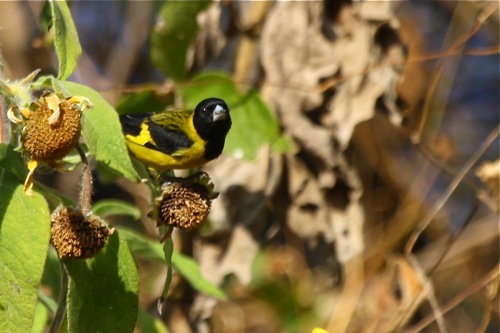
are no common name changes.7. Like Piranga, the genera Habia (ant-tanagers) and Chlorothraupis (Carimol's/Olive and Lemon-spectacled Tanager) move from Thraupidae to Cardinalidae. There are no common name changes.
8. The genus Amaurospiza (Blue Seedeater) moves from Emberizidae to Cardinalidae.
 9. The genus Saltator (the
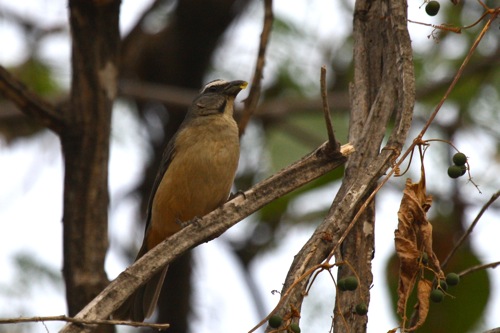
saltators) is moved from Cardinalidae to Incertae Sedis (place unknown).
9. The genus Saltator (the
saltators) is moved from Cardinalidae to Incertae Sedis (place unknown).10. The Lesser Antillean genus Cichlherminia (Forest Thrush) is merged into Turdus.
11. The scientific name of White-necked Puffbird changes to Notharchus hyperrhynchus as the Guianan Puffbird is split off as N. macrorhynchos.
12. The common name of Vireo caribaeus changes from St. Andrew Vireo to San Andrés Vireo.
13. The following species are moved from Carduelis to Spinus.
Spinus atriceps Black-capped Siskin
Spinus notatus Black-headed Siskin
Spinus xanthogastrus Yellow-bellied Siskin
Spinus cucullatus Red Siskin
Spinus dominicensis Antillean Siskin
=============================================
The 2008 AOU and ABA checklist supplements include seven changes that will impact birders in North America.
1. Greater Flamingo (Phoenicopterus roseus) split from American Flamingo (P. ruber). The lumped species was know as Greater Flamingo. Only American Flamingo occurs naturally in North America. In addition, the flamingo order, Phoenicopteriformes, has changed position. It now occurs after the grebes on the checklist, to show its relatedness with that group.
2. Spot-billed Duck was split into Indian Spot-billed Duck (Anas poecilorhyncha) and Eastern Spot-billed Duck (A. zonorhyncha). Only the latter has occurred naturally in North America.
3. There was an overhaul in gull taxonomy, with many old genera resurrected. The new scientific names and new checklist order are shown below. Species which underwent a changes in scientific name are denoted with an asterisk (*).
Creagrus furcatus Swallow-tailed Gull
Rissa tridactyla Black-legged Kittiwake
Rissa brevirostris Red-legged Kittiwake
Pagophila eburnea Ivory Gull
Xema sabini Sabine’s Gull
*Chroicocephalus philadelphia Bonaparte’s Gull
*Chroicocephalus cirrocephalus Gray-hooded Gull
*Chroicocephalus ridibundus Black-headed Gull
*Hydrocoloeus minutus Little Gull
Rhodostethia rosea Ross’s Gull
*Leucophaeus modestus Gray Gull
*Leucophaeus atricilla Laughing Gull
*Leucophaeus pipixcan Franklin’s Gull
Larus belcheri Belcher’s Gull
Larus crassirostris Black-tailed Gull
Larus heermanni Heermann’s Gull
Larus canus Mew Gull
Larus delawarensis Ring-billed Gull
Larus occidentalis Western Gull
Larus livens Yellow-footed Gull
Larus californicus California Gull
Larus argentatus Herring Gull
Larus michahellis Yellow-legged Gull
Larus thayeri Thayer’s Gull
Larus glaucoides Iceland Gull
Larus fuscus Lesser Black-backed Gull
Larus schistisagus Slaty-backed Gull
Larus glaucescens Glaucous-winged Gull
Larus hyperboreus Glaucous Gull
Larus marinus Great Black-backed Gull
Larus dominicanus Kelp Gull
4. Green Violet-ear has been renamed Green Violetear, without the hyphen.
5. Many of the Turdus thrushes have had their common names changed from robin to thrush. For North Americans, this only affects “Mexican” species. So, White-throated Robin becomes White-throated Thrush and Clay-colored Robin becomes Clay-colored Thrush. American Robin is certainly never going to change names, and the retention of the name Rufous-backed Robin for its close relative may be due to that relatedness, though this was not explicitly stated.
6. A motion to split "American Herring Gull" (Larus argentatus smithsonianus) from Herring Gull was defeated.
7. The only ABA change that will likely affect many birders is the addition of the South Florida population of Common Myna to the list of countable exotics.
~There are also many 2008 AOU changes in Middle America, including . . .
1. Slender-billed Kite changes from (Rostrhamus hamatus) to (Helicolestes hamatus).
2. Mangrove Black-Hawk (Buteogallus subtilis) is lumped into Common Black-Hawk. (B. anthracinus).
3. The genus Pyrilia was split from the genus Pionopsitta. Consequently, Saffron-headed Parrot changes from Pionopsitta pyrilia to Pyrilia pyrilia, and Brown-hooded Parrot changes from Pionopsitta haematotis to Pyrilia haematotis.
4. All members of the genus Colibri lose the hyphen in their common names; thus, all violet-ears become violetears.
5. The common name of Goethalsia bella changes from Rufous-cheeked Hummingbird to Pirre Hummingbird.
6. Nonnula frontalis (Gray-cheeked Nunlet) split from N. ruficapilla (Rufous-capped Nunlet).
7. Some members of the genus Piculus are moved to Colaptes, including Golden-olive Woodpecker (Colaptes rubiginosus) and Gray-crowned Woodpecker (C. auricularis).
8. The enigmatic Sapayoa (Sapayoa aenigma) has been placed in the family Eurylaimidae, along with the Old World suboscines: pitas, asities, and broadbills.
9. Checker-throated Antwren changes from Myrmotherula fulviventris to Epinecrophylla fulviventris.
10. The family Formicariidae (“ground antbirds”) is split three ways. The antthrushes (Formicarius and Chamaeza) remain in Formicariidae. The true antpittas (Grallaria, Hylopezus, Grallaricula) get a new family, Grallariidae The “gnatpittas” of the genus Pittasoma are moved into the gnateater family, Conopophagidae.
11. The common name of Cnipodectes subbrunneus changes from Brownish Flycatcher to Brownish Twistwing.
12. Yellow-throated Flycatcher (Conopias parvus) and White-ringed Flycatcher (C. albovittatus) are split.
13. Most of the Turdus thrushes have had their common names changed from robin to thrush. Thus, we now have Sooty Thrush, Bare-eyed Thrush, Clay-colored Thrush, White-throated Thrush, Black Thrush, and Mountain Thrush. American Robin is certainly never going to change names, and the retention of the names Rufous-collared Robin and Rufous-backed Robin for its close relatives may be due to that relatedness, though this was not explicitly stated.
14. The common name of Chlorothraupis carmioli changes from Olive Tanager to Carimol’s Tanager.
15. Sooty-faced Finch (Lysurus) and Green-striped, Stripe-headed, and Chestnut-crowned Brushfinches (Buarremon) are merged into the genus Arremon.
16. Troupial is split into Venezuelan Troupial (Icterus icterus), Orange-backed Troupial (I. croconotus), and Campo Troupial (I. jamacaii).
17. ʻAnianiau gets its own genus, so it changes from Hemignathus parvus to Magumma parva.
~ Here's a run-down of the most noteworthy changes to appear in lthe 2007 Supplement of the AOU Checklist.
- Cathartidae (New World vultures) was moved out of Ciconiiformes (storks) and back into Falconiformes (hawks and falcons), though the authors state that even this placement is tentative.
- Bean Goose was split into two species: Taiga Bean-Goose (Anser fabalis) and Tundra Bean-Goose (Anser serrirostris). Both species have been recorded in North America as vagrants.
- Cuban Black-Hawk (Buteogallus gundlachii) was split from Common Black-Hawk (B. anthracinus).
- Spizastur, the now defunct monotypic genus of Black-and-white Hawk Eagle, was
merged into Spizaetus. It appears Black-and-white
Hawk-Eagle is the sister taxon to Ornate Hawk-Eagle.
- Larus michahellis (including atlantis) was split from L.
cachinnans but retained the name Yellow-legged
Gull. The latter is now called Caspian Gull and has no proven
records in North America as of yet.
- Belted and Ringed Kingfishers get a new genus as Megaceryle is split from Ceryle. The change in gender in the genus name affects the specific epithet of Ringed Kingfisher, which changed from Ceryle torquatus to Megaceryle torquata.